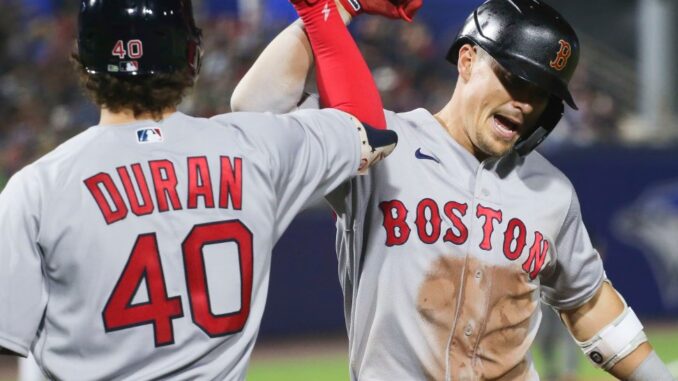
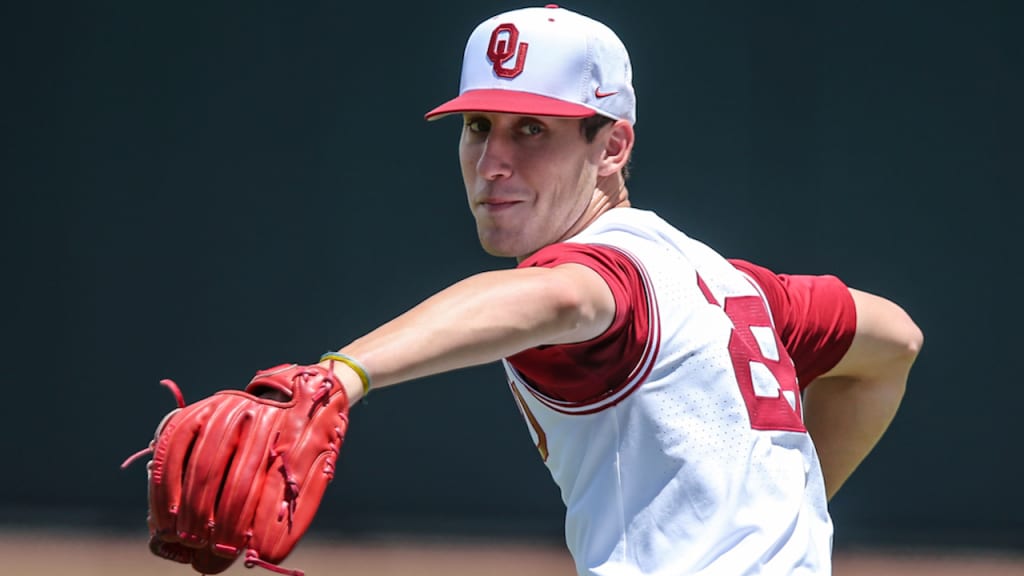
The Boston Red Sox continued to feel the ripple effects of last summer’s blockbuster Rafael Devers trade on Sunday, dealing right-handed pitching prospect David Sandlin to the Chicago White Sox in a transaction centered around reliever Jordan Hicks. Boston officially announced the move on its social media channels, confirming that the club received 22-year-old right-handed pitching prospect Gage Ziehl in return.
The deal highlights just how dramatically the Devers trade reshaped both the Red Sox roster and their financial outlook. Hicks was one of the key pieces acquired from the San Francisco Giants, along with left-hander Kyle Harrison, highly regarded outfield prospect James Tibbs III, and Rookie League arm Jose Bello. Since then, Boston has steadily dismantled that return package. Tibbs III was shipped to the Los Angeles Dodgers at last year’s trade deadline in exchange for pitcher Dustin May, and now Hicks and Sandlin are also gone, leaving Harrison and Bello as the only remaining pieces from the original Devers deal.
Sandlin’s inclusion in the trade stands out, as he was once viewed as a potential mid-rotation starter for Boston. Acquired from the Kansas City Royals in February 2024 in exchange for reliever John Schreiber, Sandlin quickly climbed prospect rankings. MLB Pipeline rated him as the No. 8 overall prospect in the Red Sox system and the No. 5 pitching prospect, praising his premium velocity and diverse pitch mix.
According to scouting reports, Sandlin’s fastball regularly sat between 94 and 97 mph and touched 100 mph. He complemented it with a sweeping slider in the mid-80s, a tighter cutter variation, and a splitter with sharp downward action. At his best, those offerings made him extremely difficult to square up. However, evaluators also expressed concerns about his delivery and long-term durability, describing him as somewhat unpredictable despite his raw talent.
Those concerns showed up in his 2024 performance. Despite solid control and quality stuff, Sandlin posted a 5.34 ERA while allowing a .269/.324/.511 slash line against. While scouts still believed he had the ceiling of a front-half rotation starter, there was also a growing sense that he could end up in the bullpen if command and consistency didn’t improve.
So why move him now, just days before spring training opens in Fort Myers, Florida? The primary reason was financial flexibility. By attaching Sandlin to Hicks’ contract, the Red Sox were able to offload most of the money owed to the struggling reliever. Hicks, who struggled badly in Boston, allowed 20 runs on 25 hits in just 18 2/3 innings, issuing 12 walks against 15 strikeouts.
The trade shifts nearly all of Hicks’ remaining salary burden to Chicago. Boston will cover $8 million of the roughly $24 million still owed over the next two seasons, meaning only a small portion will count toward the club’s competitive balance tax. This maneuver drops the Red Sox further below the luxury tax threshold, aligning with the organization’s ongoing effort to manage payroll.
In addition to the financial relief, the trade clears two spots on Boston’s 40-man roster, potentially signaling that more roster moves could be on the way as spring training approaches. While parting with Sandlin was a difficult decision, it reflects Boston’s continued emphasis on flexibility and cost control as it charts its next phase.
Leave a Reply